

The Profectus Method: A Framework for Sustainable Business Growth
Uniting market maturity and operational strength for lasting success


Seeing Beyond the Surface - Aligning Commercial Forces for Long-term Growth
Commercial excellence is a slippery phrase. To some leaders it means better sales; to others, stronger marketing or sharper business development. For the purposes of this article, I define “commercial” as the combined functional engine of marketing, sales, and business development. Excellence, then, is when these three engines are aligned, guided by shared strategies and Key Performance Indicators (KPIs), and ultimately driving growth beyond plan.
Here’s the hard part: in most organizations, these functions sit in silos. Each has its own leader, its own metrics, its own priorities. Coordination is often the exception, not the rule. And without shared accountability, what real incentive exists to ensure colleagues succeed? My work is about surfacing these gaps and helping organizations bring their commercial functions into one conversation.
When I evaluate an organization’s commercial health, I rely on what I call the Profectus Method — a framework built on two lenses: Market Maturity and Functionality. My role is not to echo the internal narrative but to hold up a mirror — one that reflects how the business stacks up against peers, industry benchmarks, and its own ambitions.
Consider a familiar scenario. A marketing team looks busy and declares itself strong. Yet the budget is $100K against competitors’ $2M, with dollars poured into brochures and RFPs instead of brand campaigns and sponsorships. Busy isn’t the same as effective. Or take forecasting: a company may proudly point to its “annual planning process,” but if that process lasts two weeks, involves only a handful of leaders, and rests on questionable data, it isn’t really planning. Effective forecasting is slow, collective, and grounded in data integrity.
That’s the core of the Profectus Method: to cut through surface activity and ask, what’s really happening here?
Market Maturity
Market maturity measures how a company shows up in the world — both in perception (brand) and in reality (sales). I assess six elements:
Growth – What has the last five years produced? Did the company hit its targets? What does the next five look like? Sustained 10% YOY growth signals stability (a “5” on my scale). Lofty ambitions of doubling the business, unsupported by track record, rate far lower — not as a critique, but as a signal of the gap between aspiration and reality.
Market Share – What portion of the market does the company own, and is it poised to grow? High share earns a 5; low share, a 1.
Marketing Spend – Is there a real budget, with a real plan? Or is marketing treated as a cost center? Investment levels reveal not just tactics, but philosophy.
Client Count – How concentrated is revenue? A company built on one or two clients carries risk; a diversified client base signals maturity.
Brand Awareness – Do people in the industry know the brand? Are there signs of presence — digital, social, events? Recognition doesn’t guarantee maturity, but lack of it usually signals immaturity.
Website Performance – Digital metrics don’t lie. Traffic, lead generation, and keyword ranking are tangible, comparable indicators of maturity.
Together, these measures paint a picture of where the company stands in its market — not as it wishes to be seen, but as it is.
Functionality
If market maturity is about how the company is perceived and performs externally, functionality is about the machinery inside. It asks: how well do roles, systems, and processes actually work?
Key elements include:
Roles and Responsibilities – Are teams and leaders clearly defined across finance, sales, marketing, IT, and legal?
Data Integrity – Can leadership track performance across clients, salespeople, and time periods with confidence? If not, decisions are guesswork.
IT Systems – Are tools modern, integrated, and leveraged? Or are processes still manual? A CRM isn’t optional for serious commercialization.
Operational Processes – Are reporting, pipeline tracking, forecasting, and performance reviews standardized and trusted, or are they ad hoc?
This lens is less about ambition and more about infrastructure. Does the company have the scaffolding to support the growth it seeks?
Using the Matrix
After rating both Market Maturity and Functionality, I average the scores and plot them on a matrix. In practice, every assessment yields a different picture.
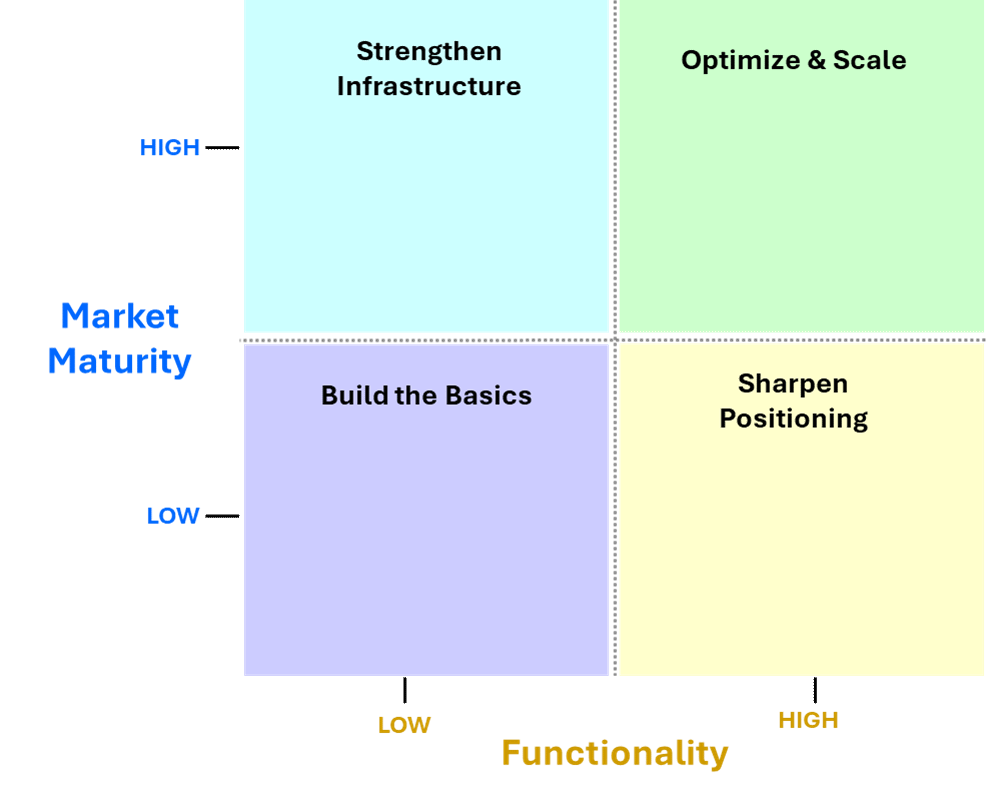
Each quadrant offers a different starting point:
Low Market Maturity / Low Functionality – Typical of early-stage companies: strong ambition, thin resources. The work here is foundational — building sales, marketing, planning, and process together.
High Market Maturity / High Functionality – The rare “well-oiled machine.” But even here, optimization is possible — fine-tuning processes, adding light training, or carefully scaling into new initiatives.
Low Market Maturity / High Functionality – Strong systems but weak presence. The mandate: sharpen positioning, brand, and commercial execution.
High Market Maturity / Low Functionality – Market presence without infrastructure. The risk is fragility. The work is to shore up systems, data, and process.
Every organization is unique; the matrix doesn’t prescribe a single path. It clarifies where to begin.
Final Thought
The Profectus Method is about honesty. It forces leaders to see both their market position and their internal capabilities without rose-colored glasses. That can be uncomfortable, but discomfort is often the starting point for growth.
If this framework resonates, and if your organization is ready to test its own market maturity and functionality, I’d be glad to help map the path forward.
Until next time—let’s tell it like it is…almost always.